
The Period of Mahajanapadas
The Period of Mahajanapadas: Formation of States in Ancient India
The sixth century BCE marked a transformative period in Indian history, witnessing the emergence of large territorial states known as Mahajanapadas. This era saw the evolution from tribal political organisations to sophisticated state formations, fundamentally reshaping the political, economic, and social landscape of the Indian subcontinent. The widespread use of iron technology in eastern Uttar Pradesh and western Bihar, coupled with agricultural surplus and urbanisation, created the conditions for these powerful kingdoms and republics to flourish.
Kautilya's Saptanga Theory: The Seven Elements of the State
The ancient political theorist Kautilya, in his seminal work the Arthashastra, outlined the Saptanga theory, describing seven essential constituent elements that formed a complete state. These elements represented a sophisticated understanding of statecraft and governance that would influence Indian political thought for centuries to come.
The King
The sovereign authority responsible for governance and decision-making
The Minister
Advisors and administrators who assisted in governing the state
The Country
The territorial extent and geographical domain of the state
The Fortified City
Urban centres providing defence and administrative control
The Treasury
Financial resources essential for state functioning
The Army
Military strength necessary for defence and expansion
The Ally
Diplomatic relationships with other states
Significantly, no state formation satisfied all seven aspects until the end of the sixth century BCE. The gradual integration of these elements reflected the increasing sophistication of political organisation during this transformative period in Indian history.
The Rise of Territorial States: Technological and Economic Foundations
Agricultural Revolution
The introduction of new agricultural tools and implements enabled peasants to produce substantial surplus, meeting the needs of the ruling class and supporting numerous urban centres. This agricultural productivity formed the economic backbone of the emerging Mahajanapadas.
Iron Technology
Archaeological evidence from excavations at Rajghat and Chirand demonstrates the widespread use of iron from the sixth century BCE onwards. This technological advancement revolutionised agriculture, warfare, and crafts, enabling the formation of large territorial states better equipped militarily.
Urbanisation
Towns emerged as centres of industry and trade, marking a significant shift from rural settlements. Cities such as Shravasti, Champa, Rajagriha, Ayodhya, Kausambi, Kashi, and Pataliputra gained substantial economic importance in the Gangetic plains.
Trade Networks
Certain cities like Vaishali, Ujjain, Taxila, and the port of Bharukachchha (Broach) developed wider economic reach, connecting distant regions through extensive trade networks. These commercial connections strengthened state power and economic prosperity.
The warrior class (Kshatriyas) played the predominant role in these newly formed states, gradually strengthening the territorial idea over older tribal affiliations. As noted by the grammarian Panini, people began owing their allegiance to the Janapada (territory) rather than the Jana (tribe), marking a fundamental transformation in political identity and organisation.
The Sixteen Mahajanapadas
In the post-Vedic period, the entire northern territory—mostly situated north of the Vindhyas and extending from the north-west frontier to Bihar—was divided into sixteen great states called the Sodasha Mahajanapadas. Buddhist texts, particularly the Anguttara Nikaya, provide the primary list of these kingdoms, though various texts offer slightly different enumerations.
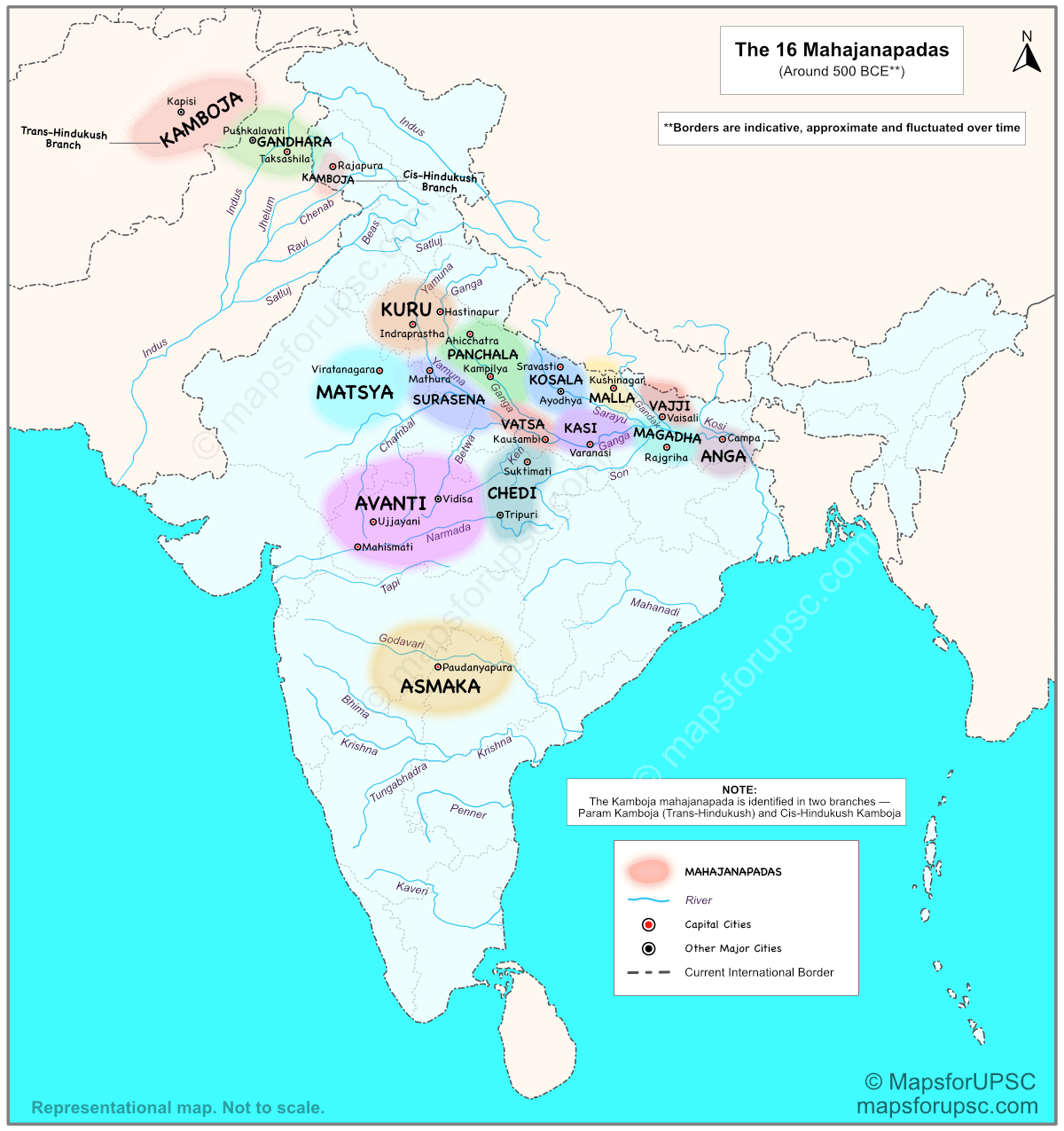
The Sixteen Mahajanapadas
Kashi
Capital: Varanasi • Most powerful before Buddha's time
Koshala
Capital: Shravasti • Ruled by King Prasenajit
Anga
Capital: Champa • Centre of trade and commerce
Magadha
Capital: Rajagriha, later Pataliputra • Most prosperous state
Vajji
Capital: Vaishali • Confederate republic
Malla
Capitals: Kushinara and Pava • Republican confederation
Chedi
Capital: Sotthivatinagara • In eastern Bundelkhand
Vatsa
Capital: Kaushambi • Famous for cotton textiles
Kuru
Capital: Indraprastha • Switched to republican government
Panchala
Capitals: Ahichchhatra and Kampilya • Originally monarchical
Matsya
Capital: Viratanagara • Suitable for cattle rearing
Shurasena
Capital: Mathura • Centre of Krishna worship
Ashmaka
Capital: Potana • Only Mahajanapada south of Vindhyas
Avanti
Capital: Ujjaini • Important centre of Buddhism
Gandhara
Capital: Taxila • Renowned centre of learning
Kamboja
Capital: Rajpur • Republican constitution
According to Buddhist texts, fourteen of these Mahajanapadas belonged to Majjhimadesa (Mid India), while Gandhara and Kamboja belonged to Uttarapatha (north-western division). Different texts provide slightly varying lists, with the Jaina Bhagavati Sutra and Mahavastu substituting certain kingdoms for others, reflecting regional perspectives and temporal variations.
Monarchies and Republics: Two Forms of Government
The sixteen Mahajanapadas represented two distinct forms of political organisation that coexisted during this period. Understanding the fundamental differences between monarchies (rajyas) and republics (ganas or sanghas) is essential to comprehending the political landscape of ancient India. These two systems reflected different philosophies of governance, social organisation, and political legitimacy.
Monarchies (Rajyas)
Concentrated in the fertile Gangetic plains
Power vested in a single hereditary king
Strong central authority and standing armies
Brahmanas exercised significant influence
Kingship attributed to divine wishes
Clear hierarchy between ruler and ruled
Examples: Magadha, Koshala, Vatsa, Avanti
Republics (Ganas/Sanghas)
Located in Himalayan foothills and Indus basin
Power shared among aristocratic clans
Governance through assemblies and councils
Brahmanas had limited influence
Leadership often elected, not hereditary
Oligarchic rather than truly democratic
Examples: Vajji, Malla, Shakya, Lichchhavi
Important Clarification: The terms "gana" and "sangha" are used synonymously in ancient texts like Panini's Ashtadhyayi and the Majjhima Nikaya. However, translating them as "republic" can be misleading. These were oligarchies where power was exercised by a group of aristocratic families, not democracies in the modern sense where all citizens have equal political rights.
The Four Great Powers: Magadha, Koshala, Vatsa, and Avanti
By the sixth century BCE, four kingdoms emerged as the most powerful states among the Mahajanapadas: Magadha, Koshala, Vatsa, and Avanti. These kingdoms engaged in complex inter-state relations involving warfare, truces, military alliances, and matrimonial connections. Their rivalry and ambitions would shape the political trajectory of the entire subcontinent for centuries to come.
Magadha
The most prosperous Mahajanapada, with its capital at Pataliputra situated at the confluence of major rivers. Rich alluvial plains and proximity to iron-ore deposits provided military and economic advantages. Eventually unified most of the subcontinent under Mauryan rule.
Koshala
Ruled by King Prasenajit, contemporary of Buddha. Capital at Shravasti, an important Buddhist centre. Successfully conquered Kashi and formed matrimonial alliances with Magadha. Eventually absorbed into Magadhan empire after internal conflicts.
Vatsa
Capital at Kaushambi, an important entrepôt for trade from north-west and south. Ruled by King Udayana, who initially opposed but later embraced Buddhism. Famous for fine cotton textiles and commercial prosperity.
Avanti
Capital at Ujjaini, an important centre of Buddhism on the southern trade route (Dakshinapatha). Ruled by the Pradyota dynasty. Eventually defeated by Magadha and absorbed into its expanding empire.
The relations among these states fluctuated over time, with shifting alliances and conflicts. Marriage alliances were an important aspect of inter-state relations, though they often became irrelevant when political ambitions took precedence. The eventual triumph of Magadha over its rivals laid the foundation for the first great empire in Indian history.
Magadha: The Rise of a Superpower
Among all the Mahajanapadas, Magadha emerged as the most prominent and prosperous state, eventually establishing its supremacy over the entire region. Located in modern-day Patna and Gaya districts of Bihar and parts of Bengal, Magadha possessed several unique advantages that propelled it to greatness. The kingdom's geographical location, natural resources, and strategic vision enabled it to overcome its rivals and establish the foundation for India's first major empire.
Agricultural Abundance
The alluvial plains of Magadha provided exceptional fertility, supporting a large agricultural surplus that sustained both the military and urban population. This economic foundation proved crucial for state building.
Iron Resources
Proximity to iron-rich areas of Bihar and Jharkhand enabled the production of superior weapons and agricultural implements. This technological advantage proved decisive in military conflicts.
Strategic Location
The capital Pataliputra was situated at the confluence of major rivers (Ganga, Son, Punpun, Gandak), facilitating trade, transportation, and military movement. This geographical advantage was unparalleled.
Strong Defences
The earliest capital Rajagriha (modern Rajgir) was naturally fortified by hills. King Ajatashatru further fortified it to protect against invasions, demonstrating Magadha's defensive capabilities.
"The special rule and the exceptional form of derivative that Panini gives to denote the ruler of the Kambojas implies that the king of Kamboja was a titular head only."
Magadha's capital shifted from Rajagriha to Pataliputra, which became one of the greatest cities of the ancient world. An active centre of both Jainism and Buddhism, Rajagriha hosted the First Buddhist Council in the Vaibhara Hills. Under successive dynasties—particularly the Mauryas—Magadha would eventually unify most of the Indian subcontinent into a single political entity, marking a watershed moment in Indian history.
Major Mahajanapadas
Anga
Capital: Champa (near modern Bhagalpur-Munger, Bihar)
Geography: Bordered by Magadha on west, Raja Mahal hills on east, Ganga on north
Economy: Great centre of trade and commerce; merchants sailed to distant Suvarnabhumi
Significance: Annexed by Magadha during Bimbisara's reign—his only conquest
Ashmaka
Capital: Potana/Potali (modern Maharashtra)
Geography: Located on Godavari river banks in Dakshinapatha (southern India)
Distinction: Only Mahajanapada south of the Vindhya mountains
History: May have come under Kashi's sway; achieved military victory over Kalinga
Avanti
Capital: Ujjaini (northern Avanti); Mahishmati (southern Avanti)
Geography: Divided by Vetravati river; modern Malwa, Nimar, parts of Madhya Pradesh
Significance: Important Buddhist centre; ruled by Pradyota dynasty
Fate: Defeated by Shishunaga of Magadha; absorbed into Magadhan empire
These three kingdoms represented the geographical diversity of the Mahajanapada period, spanning from the eastern Gangetic plains (Anga) to the southern Deccan (Ashmaka) and the western Malwa plateau (Avanti). Each possessed distinct economic strengths and cultural characteristics that contributed to the rich tapestry of ancient Indian civilisation.
Gandhara
Capital: Takshashila (Taxila), a renowned centre of learning
Location: Modern Peshawar and Rawalpindi districts (Pakistan) and Kashmir valley
Education: Taxila University attracted scholars worldwide; Panini and Kautilya studied here
Ruler: King Pukkusati/Pushkarasarin (mid-6th century BCE), contemporary of Bimbisara
Trade: Located on Uttarapatha; channel for communication with ancient Iran and Central Asia
Fate: Conquered by Persians under Darius in late 6th century BCE (per Behistun inscription)
Kamboja
Capital: Rajpur (modern Rajori); around Punchh area of Kashmir
Geography: Regions on either side of the Hindu Kush mountains
Government: Republican constitution (per Kautilya's Arthashastra and Ashoka's Edict XIII)
Structure: King was titular head; effective power vested in republican institutions
History: Mentioned in Mahabharata as having several Ganas (Republics)
Fate: Fell to Achaemenid Persians; formed part of 20th and richest satrapy with Gandhara
Kashi
Capital: Varanasi (between Varuna and Asi rivers)
Power: Most powerful Mahajanapada before Buddha's time
Prosperity: Jataka tales speak highly of its opulence and commercial success
Conflicts: Long struggle for supremacy with Koshala, Anga, and Magadha
Industry: Leading textile manufacturer; famous for Kashaya (orange-brown robes for Buddhist monks)
Fate: Eventually absorbed into Koshala kingdom during Buddha's lifetime
Koshala, Kuru, and Malla
These three kingdoms represented different aspects of the political evolution during the Mahajanapada period—from powerful monarchies to republican confederacies, each contributing uniquely to the historical and religious landscape of ancient India.
Koshala
Territory: Modern Awadh (central and eastern Uttar Pradesh), bounded by Sadanira, Gomati, and Nepal hills
Capitals: Shravasti (north), Kushavati (south); important towns included Saketa and Ayodhya
Ruler: King Prasenajit (Pasenadi), highly educated contemporary of Buddha
Alliances: Matrimonial ties with Magadha; sister married to Bimbisara with Kashi as dowry
Expansion: Conquered Kashi; extended power over Shakyas of Kapilavastu
Decline: Bitter struggle with Magadha after Bimbisara's death; ultimately merged into Magadha under Vidudabha
Kuru
Location: Modern Thanesar, Delhi, and Meerut district (Uttar Pradesh)
Capital: Indraprastha (near modern Delhi)
Dynasty: Ruled by Yuddhitthila gotta (family of Yudhishthira) per Buddhist tradition
Government: Switched from monarchical to republican form (6th-5th centuries BCE)
Ruler: Titular chieftain Korayvya during Buddha's time; followed Rajashabdopajivin constitution
Decline: Did not occupy the same prominent position as in Vedic period
Malla
Structure: Confederacy of nine clans with republican governance
Capitals: Kushinara (modern Kasia) and Pava (modern Padrauna)
Alliances: Formed defensive alliance with Lichchhavis
Religious Significance: Buddha attained Mahaparinirvana at Kushinara; Lord Mahavira at Pava
Assembly: Members called themselves rajas; ruled from Santhagara (assembly hall)
The Vajji Confederacy: A Republican Experiment
The Vajji (Vrijji) confederacy represented one of the most sophisticated republican political systems in ancient India. Located in eastern India north of the Ganga and extending up to the Nepal hills, this confederacy demonstrated that alternatives to monarchical rule could be both viable and prosperous. The Vajji confederacy is particularly significant for students of political history as it provides insights into ancient republican governance systems.
Vajjis
The primary clan that gave the confederacy its name
Lichchhavis
The most prominent members; Vaishali was their capital
Videhas
With capital at Mithila (modern Janakpur in Nepal)
Jnatrikas
Based in Kundapura; Mahavira belonged to this clan
Nayas
Important constituent clan of the confederacy
Other Clans
Several smaller clans completing the eight-clan structure
Administrative Structure
The Vajji Sangha consisted of several janapadas, gramas (villages), and gosthas (groups). Eminent people were chosen from each khanda (district) as representatives called gana mukhyas. The chairman, titled gana pramukha, was often addressed as king though his post was neither dynastic nor hereditary.
Mahabaladhrikrita: Minister of internal security
Binishchayamatya: Chief justice
Dandadhikrita: Other justices and legal officers
Religious Significance
Vaishali held immense religious importance as a centre of Buddhism and Jainism. Both Mahavira and Gautama Buddha visited Vaishali numerous times during their lifetimes. The city became a major pilgrimage site, and the Second Buddhist Council was held here.
The Vajji confederacy was led by Chetaka, brother of Trishala (Mahavira's mother) and father of Chellana (wife of Magadhan king Bimbisara). This web of familial relationships demonstrates the complex interconnections between republican and monarchical states. The confederacy's eventual defeat by Magadha under Ajatashatru marked a turning point in Indian political history, signaling the triumph of centralised monarchical power over republican federations.
Republican Governance: Structure and Functioning
The republican states (ganas or sanghas) of ancient India developed sophisticated systems of governance that, while not democratic in the modern sense, represented significant alternatives to absolute monarchy. Understanding their structure is crucial for appreciating the diversity of political thought in ancient India. These systems demonstrate that Indian political philosophy encompassed various forms of governance beyond kingship.
Ruling Families (Rajakulas)
Heads of aristocratic Kshatriya families formed the core of governance. In the Lichchhavi republic, reportedly 7,707 rajas (though this number should be understood as representing a large assembly rather than taken literally) comprised the ruling assembly.
Assembly Meetings (Santhagara)
Representatives met in assembly halls called santhagara to discuss important business including alliances, warfare, and peace treaties. Meetings were announced by drum beats, with a regulator ensuring proper seating arrangements.
Voting Procedures
Decisions were made through voting using wooden pieces called salakas. The salaka-gahapaka, chosen for honesty and impartiality, collected votes. The gana-puraka ensured quorum requirements were met for major deliberations.
Leadership Positions
The assembly elected leaders with titles such as ganapati, ganajyestha, ganaraja, or sanghamukhya. Unlike monarchies, this position was not necessarily hereditary, though in practice ruling families dominated. The Lichchhavis had raja, uparaja, senapati, and bhandagarika positions.
"When Simha wanted to step aside in favour of his eldest brother, the members of the assembly plainly told him that the office did not belong to his family but to the assembly of the tribe."
Important Note : Early nationalist historians tended to glorify the ganas by exaggerating their democratic features, partly to counter Western assertions that Indians had only known despotic rule. However, it is crucial to understand that these were oligarchies, not democracies. Power was restricted to aristocratic Kshatriya families, and groups like Brahmanas, farmers, artisans, labourers, and slaves had no political participation rights despite living in these territories.
The requirement for unanimity in decision-making meant that all important issues required consensus among assembly members. This procedural characteristic may have influenced the Buddhist monastic order (sangha), whose procedures bore similarities to the sangha polities, especially the Lichchhavis.
Oligarchic Nature of Republics: Limitations on Participation
While the ganas represented alternatives to absolute monarchy, characterising them as democracies would be historically inaccurate. They were oligarchies where power remained concentrated in the hands of aristocratic families. Understanding this distinction is essential for a nuanced appreciation of ancient Indian political systems and avoiding romanticised interpretations.
Kshatriya Dominance
The ganas were closely associated with ruling Kshatriya clans and named after them. Members were linked through real or claimed kinship ties. Only these aristocratic families had political rights and could attend assemblies.
Excluded Classes
Brahmanas, farmers, artisans, wage labourers, and slaves lived in these territories but had subordinate status politically, economically, and socially. They could not use the clan name and had no participation rights.
Gender Exclusion
Women were significantly not included in assemblies or political decision-making processes. This gender-based exclusion further limited the representative nature of these governments.
Wealth Requirements
In post-Maurya republics like those of the Malavas and Kshudrakas, citizenship was restricted to Kshatriyas and Brahmanas. In one Punjab state, membership required the ability to supply at least one elephant—a clear wealth-based restriction.
Examples of Exclusion
Specific examples illuminate the hierarchical nature of these republics:
Upali the barber who lived in Sakya territory could not attend assemblies despite residing there
Chunda the metal smith in Malla territory similarly lacked political rights
Brahmanas were not included among the 7,707 Lichchhavi rajas who comprised the assembly
Slaves and hired labourers were explicitly excluded from citizenship in post-Maurya republican constitutions
Authoritarian Measures
Republican governments exercised strict control over their domains. A Buddhist narrative records that the Mallas issued a decree enforcing a welcome for Buddha, backed by heavy fines for non-compliance. Jataka stories mention the Shakyas banning marriages with people of "low status" and prohibiting people of unequal birth from dining together. These authoritarian laws controlling private and family life reveal the non-democratic character of these states.
The republics thus represented what some historians call "distorted republics"—they retained the essential organisational and ideological features of monarchies while distributing power among a small elite rather than concentrating it in one individual. Their inability to include broader sections of society in governance contributed significantly to their eventual decline and defeat by more unified monarchical states.
Origins and Characteristics of Republican States
Understanding why republican forms of government emerged in certain regions of ancient India requires examining the socio-political conditions, geographical factors, and ideological movements of the period. The ganas represented both continuity with older tribal traditions and reactions against emerging hierarchical structures in Vedic society.
Tribal Continuity Theory
Some republics in the Indus basin may have been remnants of Vedic tribes maintaining older traditions of collective decision-making. These preserved elements of tribal equality that didn't elevate the raja to supreme authority.
Reaction Against Vedic Orthodoxy
The movement against Vedic life opposed growing class and sex distinctions, superstitious practices that harmed cattle-stock, and hereditary kingship supported by Brahmanas who claimed exclusive rights and privileges.
Breakaway Movements
Traditional stories indicate republicans often broke away from parent monarchical states. The Shakyas (Buddha's tribe) supposedly descended from Koshala's royal house—four brothers and sisters expelled by their father who then intermarried to preserve racial purity.
Transformation from Monarchy
Some states like Videha and Vaishali were originally monarchies that transformed into republics. The Kurus were monarchical during Buddha's time but became a gana later, demonstrating fluidity in political forms.
Economic Factors
In early periods, ruling class members shared war booty and tributes. When tribal chiefs later monopolised revenues in territorial states, leading tribe members demanded tax collection rights and the right to maintain armies, giving birth to republican frameworks.
Geographical Distribution
While monarchies concentrated in the fertile Gangetic plains, republics existed either in the Indus basin or near Himalayan foothills in eastern Uttar Pradesh and Bihar. Smaller state sizes in these regions made representative governance more feasible.
Social Philosophy
Republican societies treated people on an equal basis, at least among ruling clans. They rejected Vedic philosophy dividing society into four distinct varnas. Buddhist and Jain ideas promoting equality were popular among these communities.
Land Ownership
In ganas, land was owned collectively by the clan rather than privately, according to some historians like Walter Ruben. However, the Kshatriya political elite were probably the largest landowners, with hired labourers and slaves working the land.
Decline of the Republics: Internal and External Factors
The republican tradition, which flourished during the 6th-5th centuries BCE, gradually weakened from the Mauryan period onwards. Understanding why these alternative political systems ultimately failed provides important insights into the dynamics of state formation and the advantages that centralised monarchical systems possessed in the context of ancient India. For UPSC aspirants, this analysis is crucial for understanding political evolution.
Internal Dissension
The chief cause of republican decline was internal quarrels between clans and groups. Great republics like the Andhaka-Vrishnis, Vajjis, and Videhas were destroyed primarily due to internal conflicts rather than external conquest alone.
Decision-Making Weaknesses
Governance through discussion and consensus—the republics' greatest asset—proved their greatest weakness. The requirement for unanimity facilitated internal dissension, particularly when facing aggressive monarchical states with unified command structures.
Limited Social Base
Power concentration in a few Kshatriya clans who refused to extend rights to other social classes limited the republics' strength. Caste arrogance prevented unity within their own territories, weakening resistance to external threats.
Monarchical Ambitions
Terms like chakravartin (universal ruler), samrat, and sarvabhauma reflected monarchical ambitions to rule all of Jambudvipa. These expansionist ideologies drove aggressive policies that republican systems couldn't effectively counter.
Military Disadvantages
Unlike monarchies with professional standing armies, republics likely lacked permanent military forces. The Lichchhavis had strong armies, but soldiers probably retired to their lands when not engaged in battle, making rapid mobilisation difficult.
Each Lichchhavi raja maintained his own small army under a senapati, creating coordination challenges. The ability to compete internally weakened their capacity for unified external defence.
Resource Limitations
Most politically important ganas were located in or near Himalayan foothills in eastern India, while major kingdoms occupied the fertile alluvial tracts of the Ganga valley. Republics' small size and limited resources made it difficult to match monarchical military strength.
Strategic Vulnerabilities
Kautilya's Arthashastra outlined special strategies for conquering ganas, primarily focused on creating dissension among their ranks. This systematic approach to exploiting republican weaknesses proved devastatingly effective.
Abandonment of Core Principles
Republics gradually abandoned the principle of electing the most meritorious person as leader. Leadership increasingly passed through hereditary succession based on birth rather than merit, undermining their foundational principles.
Historical Pattern: After the Mauryan decline, republics briefly resurged and flourished for a couple of centuries. However, the imperial Guptas pursuing expansion policies ultimately destroyed them. Some were conquered by Chandragupta I, most by Samudragupta, and the remainder by Chandragupta II, marking the final end of the republican tradition in ancient India.
Monarchical States: Structure and Characteristics
While republics represented alternative political organisations, monarchies became the dominant form of governance in the Mahajanapada period, particularly in the fertile Gangetic plains. Understanding monarchical structures is essential for comprehending how these states successfully expanded, eventually unifying large territories under centralised rule. The sophistication of monarchical administration laid foundations for later imperial formations.
Royal Authority
The king enjoyed sovereign power and was the centre of all governmental functions. He could compel obedience to laws and use force when necessary. Kingship was increasingly attributed to divine wishes, strengthening royal authority and legitimacy.
Brahmana Influence
Unlike in republics, Brahmanas exercised great influence in monarchies. The earlier rivalry between Brahmanas (priests) and Kshatriyas (rulers) transformed into mutual support. Importance of priests and Vedic rituals significantly increased, legitimising royal authority.
Revenue System
Kings transitioned from voluntary tributes (as in earlier periods) to compulsory tax collection. Major taxes included bali (tribute), bhaga (share of produce), kara (taxes), and shulka (toll duties). The king typically claimed one-sixth of agricultural produce.
Military Organisation
Monarchies maintained regular standing armies under central command. This contrasted sharply with republics where each raja kept separate forces. Professional armies with cavalry, infantry, chariots, and elephants provided military advantages.
Administrative Machinery
The most important feature of monarchical administration was the rise of a class of officials known as mahamatras. These professional administrators managed various aspects of governance:
Sarvarthaka: Officials managing general affairs
Vyavaharika: Judicial officials administering justice
Sena Nayaka: Military commanders leading armies
Rajjugahakas: Officers conducting cadastral surveys and measuring the king's share in produce
Ganaka: Chief accountants managing state finances
Grama-bhojaka: Village headmen—the most important revenue collecting authorities
Shaulikika/Shulkadhyaksha: Toll officers managing trade duties
"A clear division existed between the ruler and the ruled, the rich and the poor. Some individuals or families possessed more lands than others, while the state claimed rights over all unused lands."
The state generally controlled the means of production and distribution. After clearing wastelands or unused land, the king received tax from cultivators. Advisory councils such as sabha and parisad assisted the king, though their power was limited compared to republican assemblies. Loyalty shifted from clans (as in earlier tribal organisations) to the individual's caste and to the king, representing a fundamental transformation in political allegiance.
Inter-State Relations and Diplomacy
The Mahajanapada period witnessed complex inter-state relations involving warfare, alliances, treaties, and matrimonial connections. Understanding these diplomatic practices is crucial for appreciating how ancient Indian states balanced competition with cooperation, and how these relationships shaped political developments. The sophistication of diplomatic practices during this period laid foundations for later treatises like Kautilya's Arthashastra.
Military Conflicts
States frequently engaged in warfare for territorial expansion, control of trade routes, and establishing dominance. Magadha's annexation of Anga, conflicts between Kashi and Koshala, and wars between Avanti and Vatsa exemplified this pattern.
Truces and Treaties
Temporary peace agreements allowed states to consolidate power and prepare for future conflicts. These arrangements were often strategic and temporary rather than permanent solutions to inter-state tensions.
Military Alliances
States formed coalitions against common threats. The Jaina tradition mentions the Lichchhavis forming leagues with Mallas and clan lords of Kashi and Koshala. The Vajjis and Mallas maintained defensive alliances.
Matrimonial Alliances
Royal marriages cemented relationships between states. Prasenajit's sister married Bimbisara with Kashi as dowry. Udayana married Pradyota's daughter Vasavadatta. However, these often became irrelevant when political ambitions arose.
Economic Relations
Trade routes connected major kingdoms, creating economic interdependencies. The Dakshinapatha linked Rajagriha to Pratishthana via Ujjain. Control over trade routes became a major source of inter-state competition.
Balance of Power
No single state achieved absolute dominance initially. The four great powers—Magadha, Koshala, Vatsa, and Avanti—maintained a relative balance until Magadha's eventual triumph through superior strategy and resources.
Notable Diplomatic Episodes
Koshala-Magadha Relations
Initially cordial through Prasenajit's sister's marriage to Bimbisara with Kashi as dowry. Relations deteriorated after Bimbisara's death, leading to bitter struggle. Eventually resolved when Lichchhavi confederacy aligned with Magadha, resulting in Koshala's absorption.
Avanti-Vatsa Rivalry
Legends recount rivalry between Udayana of Vatsa and Pradyota of Avanti. Despite conflicts, they were connected through marriage when Udayana married Vasavadatta, Pradyota's daughter. This romance became subject of later Sanskrit dramas by Bhasa and Harsha.
Gandhara's Foreign Relations
King Pukkusati maintained cordial relations with Magadha while successfully waging war against Avanti. However, Gandhara's location made it vulnerable to Persian expansion, eventually falling to the Achaemenids under Darius.
Cultural and Religious Developments
The Mahajanapada period witnessed profound cultural and religious transformations that would shape Indian civilisation for millennia. The emergence of Buddhism and Jainism, the establishment of great centres of learning, and the flourishing of urban culture occurred against the backdrop of political developments. Understanding these cultural dimensions is essential for a holistic appreciation of this period.
Rise of Buddhism
Gautama Buddha's teachings found receptive audiences in both monarchies and republics. Important centres included Rajagriha (First Buddhist Council), Vaishali (Second Buddhist Council), Shravasti, and Kushinara (Buddha's Mahaparinirvana). King Bimbisara, Prasenajit, and Udayana became notable royal patrons.
Jainism's Spread
Lord Mahavira, belonging to the Jnatrika clan of the Vajji confederacy, propagated Jain teachings throughout the region. His mother was a Lichchhavi princess, connecting Jainism to republican aristocracy. Mahavira attained Nirvana at Pava, making it a major Jain pilgrimage site.
Educational Centres
Taxila University in Gandhara became a renowned centre of learning attracting scholars worldwide. Great thinkers including Panini (grammarian) and Kautilya (political theorist) studied here. Other cities like Mithila also emerged as important intellectual centres.
Urban Culture
Prosperous cities like Vaishali, Kaushambi, Ujjain, Rajagriha, and Shravasti became centres of sophisticated urban culture. Wealthy merchants, artisans, and professionals created vibrant cosmopolitan societies that patronised arts, crafts, and philosophy.
Economic Specialisation
Different regions developed specialised industries: Kashi for textiles (especially Kashaya robes), Vatsa for fine cotton, Mathura as a craft centre. This economic specialisation fostered inter-regional trade and cultural exchange.
Linguistic Developments
Panini's Ashtadhyayi systematised Sanskrit grammar. Pali emerged as the language of Buddhist texts. Various Prakrits served as vernacular languages. This linguistic diversity reflects the period's cultural richness and intellectual vitality.
Significance : The Mahajanapada period's cultural and religious developments represent more than historical facts—they illustrate how political, economic, and social changes create conditions for intellectual and spiritual movements. Buddhism and Jainism's challenge to Vedic orthodoxy paralleled republican challenges to monarchical power, reflecting broader societal transformations.
Republic vs. Democracy: Important Distinctions
A common misconception involves conflating ancient Indian ganas with modern democracies. Understanding the distinction between republics, democracies, and monarchies is crucial for accurate historical analysis and relevant for contemporary political understanding. This clarification is particularly important for UPSC aspirants who must demonstrate nuanced understanding of political concepts.
Monarchy
A form of government where governance is carried out by a private individual (king or emperor) who is not accountable to anybody else. Power is hereditary and concentrated in one person. The monarch's authority is typically justified through divine sanction or traditional legitimacy.
Democracy
A form of government where governance is carried out by representatives elected by the people. In pure democracy without constitutional constraints, these elected representatives would not be answerable to any fixed rules while governing, potentially leading to majority tyranny.
Republic
A government where governance must abide by a predefined set of rules, generally called the "Constitution." Those who govern should always follow these constitutional rules and never violate them. A republic can be democratic (elected representatives) or oligarchic (selected elite).
Why Ancient Indian Ganas Were Not True Democracies
Limited Franchise
Not everyone had the right to choose representatives. Only the upper layers of society—primarily Brahmanas and Kshatriyas in some cases, only Kshatriyas in others—could participate in assemblies and decision-making.
Hereditary Privilege
Political participation was largely determined by birth into ruling clans rather than citizenship or merit. The Lichchhavi assembly of 7,707 rajas represented hereditary Kshatriya families, not elected representatives of all residents.
Excluded Groups
Large segments of society—including farmers, artisans, labourers, slaves, and all women—had no voice in governance despite living in these territories and being subject to their laws.
Oligarchic Reality
Power was concentrated in aristocratic families who controlled assemblies. Wealth requirements (like supplying an elephant) further restricted participation. The term "oligarchy" (rule by few) more accurately describes these systems than "democracy" (rule by people).
Authoritarian Elements
Ganas could enforce strict laws controlling private life, impose heavy fines, and pronounce exile or death sentences. The republican form didn't prevent authoritarian governance or ensure individual freedoms.
"In republic Mahajanapadas, there was no real democracy as not everyone had the right to choose their representatives. Only the upper layer of society like Brahmanas and Kshatriyas had a chance to have say in the representations."
Understanding these distinctions helps avoid anachronistic interpretations that project modern democratic ideals onto ancient political systems. While the ganas represented important alternatives to absolute monarchy and demonstrated that Indian political thought encompassed diverse governance forms, they were oligarchic republics rather than democracies in any modern sense.
Historical Significance and Legacy of the Mahajanapada Period
The Mahajanapada period represents a watershed moment in Indian history, marking the transition from tribal societies to complex state formations. The political, economic, social, and cultural developments of this era laid foundations for subsequent empires and profoundly influenced the trajectory of Indian civilisation. For UPSC aspirants, understanding this period's significance provides essential context for comprehending later historical developments.
Foundation for Empire
Magadhan Ascendancy
Mauryan Unification
Administrative Innovations
State Formation Principles
Key Takeaways
Political Evolution
The period demonstrates how technological change (iron), economic development (agricultural surplus, trade), and social transformation (urbanisation) drive political evolution from tribal to territorial states.
Diversity of Governance
Coexistence of monarchies and republics proves Indian political thought encompassed multiple governance models, challenging narratives of monolithic despotism. This diversity reflects sophisticated political experimentation.
Religious Transformation
Buddhism and Jainism's emergence during this period illustrates how socio-political changes create conditions for religious reform movements. These religions' emphasis on equality resonated in societies questioning Vedic hierarchies.
Economic Foundations
Understanding the economic basis of state power—agricultural surplus, trade networks, resource control—is crucial for analysing any historical period. Economic factors often determine political outcomes.
Inter-State Dynamics
The complex web of alliances, conflicts, and diplomatic relations demonstrates that ancient Indian states engaged in sophisticated realpolitik. Kautilya's Arthashastra later codified these practices.
Centralisation vs. Decentralisation
The triumph of centralised monarchies over republics illustrates advantages of unified command in empire-building, though republics periodically re-emerged, showing their continued appeal and viability under certain conditions.
Enduring Legacy
The Mahajanapada period's legacy extends far beyond its chronological boundaries:
Magadha's rise established patterns of Gangetic plain dominance lasting centuries
Buddhist and Jain philosophies shaped Indian thought for over two millennia
Administrative innovations influenced Mauryan and later imperial systems
Trade networks established during this period continued expanding
Urban centres founded then remained important throughout history
Intellectual achievements (Panini's grammar, early philosophical texts) provided foundations for later developments
The period's most profound legacy lies in demonstrating that successful state formation required integrating Kautilya's seven elements: effective leadership, competent administration, secure territory, fortified cities, adequate finances, strong military forces, and strategic alliances. Magadha's eventual triumph resulted from successfully synthesising these elements more effectively than its rivals.
The Mahajanapada period exemplifies how to analyse any historical era: examine technological, economic, social, political, and cultural dimensions in their interconnections. Avoid simplistic narratives—appreciate complexity, diversity, and contingency. Recognise that historical actors operated within constraints while exercising agency, that political forms evolved through contestation, and that economic foundations ultimately shaped political possibilities. This analytical framework, honed through studying the Mahajanapada period, will serve you throughout your historical studies and beyond.
